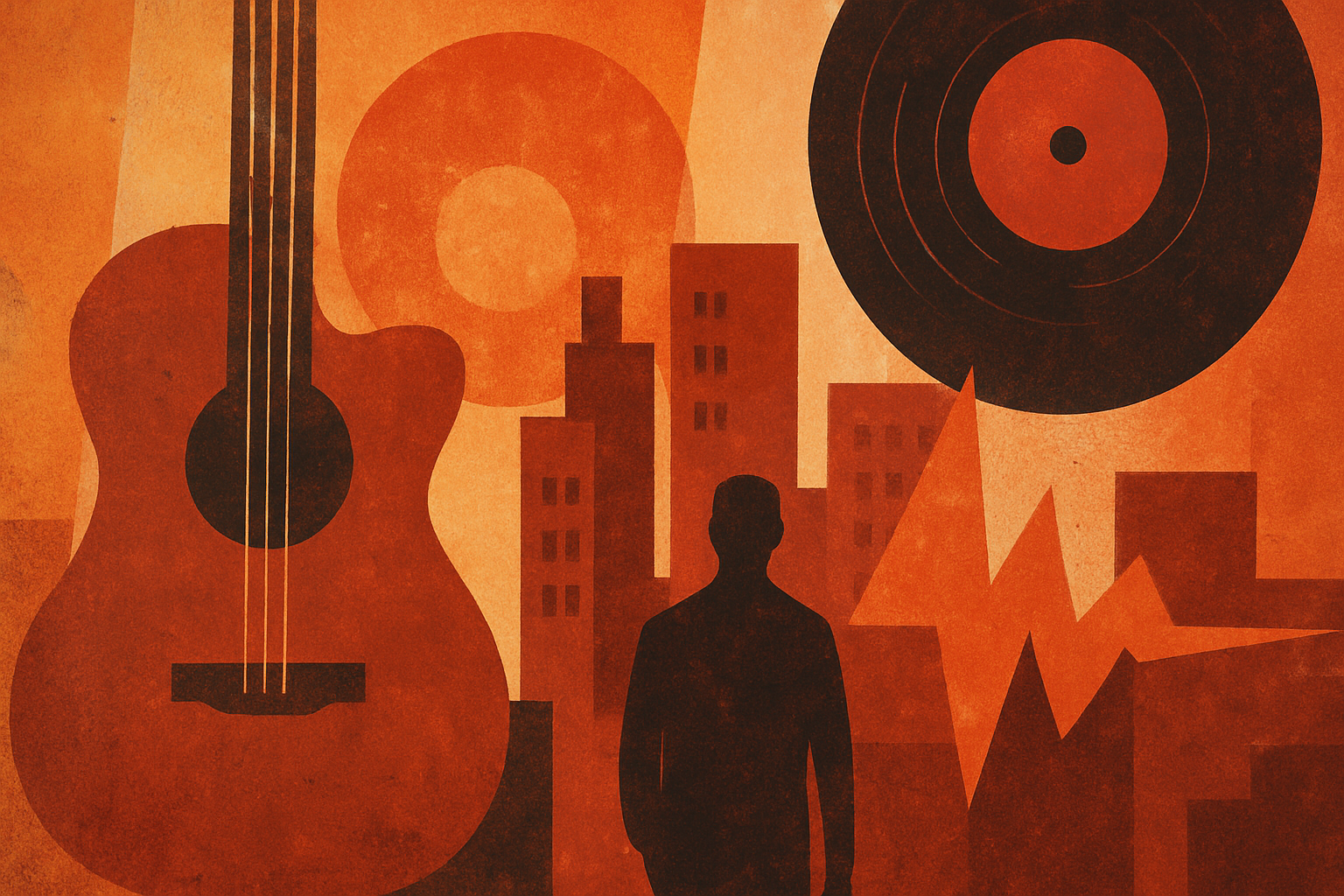
The standard history of rock ’n’ roll often emphasizes the myth of individual genius — the guitar hero, the charismatic frontman, the transcendent songwriter. Yet this focus obscures the degree to which rock is inseparable from its environments: the neighborhoods that provided space for experimentation, the cultural traditions that reshaped its language, the accidents that defined its sonic identity, and the underground networks that carried it across borders. Rock’s story, when viewed through these lenses, is less about singular figures and more about the structural, cultural, and contingent forces that made the genre possible.
The City as an Incubator
Urban geography shaped the growth of rock as much as musical innovation. Rock scenes flourished in liminal, often neglected neighborhoods where economic decline created cultural possibility. Cities were incubators where diverse communities intersected, producing hybrid sounds and subcultures.
- The Bowery, New York City: In the 1970s, the Bowery was a district of decayed tenements and abandoned storefronts. The establishment of CBGB in 1973 exploited this environment: low rents and permissive landlords allowed Hilly Kristal to run a venue that would become the epicenter of American punk (McNeil & McCain, 1996). The venue’s gritty, improvisatory ethos reflected the surrounding urban decay, allowing bands like Television, Patti Smith, and the Ramones to emerge from the margins.
Detroit’s Cass Corridor: The collapse of the auto industry left Detroit hollowed out by the late 1960s. In this vacuum, the MC5 and The Stooges emerged from the Cass Corridor, their proto-punk sound inseparable from the social and spatial disintegration around them (Smith, 2011). The city’s post-industrial architecture and communal spaces provided a raw canvas for experimentation, blending political urgency with sonic aggression.
San Francisco’s Haight-Ashbury: Unlike New York and Detroit, Haight-Ashbury’s role derived from permissive zoning and inexpensive Victorian houses easily converted into communes. These spatial arrangements nurtured psychedelic collectives such as the Grateful Dead and Jefferson Airplane (Perry, 1984). The physical environment of shared living, informal jam sessions, and neighborhood concerts reinforced collective creativity and non-hierarchical musical production.
Liverpool and Manchester: Across the Atlantic, port cities in the UK such as Liverpool and industrial centers like Manchester provided unique sonic incubators. Liverpool’s status as a trade hub facilitated exposure to American R&B and rock’n’roll records, fostering the rise of The Beatles, while Manchester’s dense working-class neighborhoods nurtured bands like The Smiths and Joy Division, who reflected urban alienation in their music (Savage, 1992).
Indigenous and First Nations Rock
Mainstream rock historiography has largely excluded Indigenous contributions. Yet Indigenous and First Nations musicians have consistently reshaped rock as a form of hybrid innovation and cultural survival.
- Redbone: A Native American band founded by brothers Pat and Lolly Vegas, combined funk grooves with rock aesthetics while foregrounding their heritage. Their 1974 single Come and Get Your Love remains one of the few mainstream chart successes by a self-identified Native rock band (Gonzalez, 2016).
- Yothu Yindi: In Australia, groups such as Yothu Yindi integrated Yolngu traditional instruments, including the didgeridoo, into rock arrangements, producing a syncretic style that contested cultural erasure while appealing to mainstream audiences (Mitchell, 1996). Their 1991 hit Treaty became a cultural landmark, blending activism and popular music.
- First Nations Punk in Canada: Punk collectives in the 1980s and 1990s — such as Aztlan Underground — utilized the raw economy of punk to articulate political resistance, using rock’s confrontational aesthetics to assert Indigenous sovereignty (Laing, 2010). These musicians often merged traditional rhythms and instruments with Western rock, creating politically charged hybrid soundscapes.
Accidents That Defined Sound
Rock’s sonic evolution was not solely the product of deliberate design; it was frequently propelled by error, improvisation, and technological quirks. These “happy accidents” often became defining elements of musical identity.
- Link Wray’s Distortion: In 1958, guitarist Link Wray punctured his amplifier’s speaker cones to achieve the distorted sound of Rumble, introducing what would become a defining timbre of rock (Waksman, 1999).
- Keith Richards’ Fuzz Riff: Initially a demo placeholder for horns, the fuzz tone used in Satisfaction became iconic, demonstrating how accidents could transform ordinary motifs into enduring signatures (Richards, 2010).
- Jimi Hendrix and Feedback: Hendrix reconceptualized feedback — previously dismissed as unwanted noise — as a musical parameter, aligning rock with avant-garde explorations of sonic texture (Doggett, 2010). His experiments expanded the palette of electric guitar sounds and influenced generations of musicians.
- The Studio as Laboratory: Technological quirks in studios also shaped rock. Tape loops, analog delay errors, and early synthesizer glitches in bands like Pink Floyd and The Beatles’ later recordings were embraced as compositional tools, illustrating the productive role of serendipity.
Rock in Exile and Underground Networks
Even under repressive regimes, rock found pathways through exile, smuggling, and underground circulation. The genre’s transnational networks facilitated cultural exchange and resistance.
- South Africa: Under apartheid, musicians such as Hugh Masekela and Johnny Clegg used exile to sustain careers abroad, blending Western rock with local traditions to amplify anti-apartheid messages (Coplan, 2008).
- Chile: Following the 1973 coup, artists like Los Jaivas and Inti-Illimani carried hybrid folk-rock abroad, transmitting politically charged music in exile (Fairley, 1984). Their work sustained a sense of cultural memory and protest across continents.
- The Soviet Union: Censorship forced fans to reproduce forbidden Western rock records on discarded x-ray films, known as “bone records,” circulating music literally imprinted on the body (Troitsky, 1988). This underground ingenuity highlights rock’s adaptability under extreme social constraints.
- Eastern Europe: In countries like Poland and Hungary, clandestine rock clubs and home-recorded bootlegs fostered local scenes despite government censorship, demonstrating rock’s ability to thrive in shadow economies.
Conclusion: Rock as Environment
Taken together, these cases reframe rock as a product of structural and contingent conditions rather than merely individual genius. Urban geography created the spaces; Indigenous musicians rearticulated its meanings; accidents redefined its sounds; and underground networks ensured its survival across borders. Rock is thus best understood not as a singular tradition but as a porous, environment-dependent practice — one that thrives in the cracks of official culture, continually reinvented by the pressures of place, circumstance, and resistance.
By acknowledging the roles of geography, culture, serendipity, and exile, we move beyond myths of rock stardom and recognize the genre as a complex, adaptive system — a living art form shaped as much by context as by individual talent.
Works Cited
- Coplan, David. In Township Tonight!: South Africa’s Black City Music and Theatre. University of Chicago Press, 2008.
- Doggett, Peter. There’s a Riot Going On: Revolutionaries, Rock Stars, and the Rise and Fall of the ’60s. Canongate, 2010.
- Fairley, Jan. “La Nueva Canción Latinoamericana.” Bulletin of Latin American Research 3.2 (1984): 107–115.
- Gonzalez, John. “Redbone: The Forgotten Native American Rock Band.” Indian Country Today, 2016.
- Laing, Dave. One Chord Wonders: Power and Meaning in Punk Rock. PM Press, 2010.
- McNeil, Legs, and Gillian McCain. Please Kill Me: The Uncensored Oral History of Punk. Grove Press, 1996.
- Mitchell, Tony. Mixing Pop and Politics: Rock Music in Czechoslovakia, Australia, and Japan. Routledge, 1996.
- Perry, Charles. The Haight-Ashbury: A History. Wenner Books, 1984.
- Richards, Keith. Life. Little, Brown, 2010.
- Savage, Jon. England’s Dreaming: Sex Pistols and Punk Rock. Faber & Faber, 1992.
- Smith, Suzanne E. Dancing in the Street: Motown and the Cultural Politics of Detroit. Harvard University Press, 2011.
- Troitsky, Artemy. Back in the USSR: The True Story of Rock in Russia. Omnibus Press, 1988.
- Waksman, Steve. Instruments of Desire: The Electric Guitar and the Shaping of Musical Experience. Harvard University Press, 1999.
Join the Discussion in the Forum Here.
For a deep dive into all the genres of history visit our annotated timeline.
Experience another facet of rock in our Rock Bible for more musical education.
Image Credit: Freepik.com