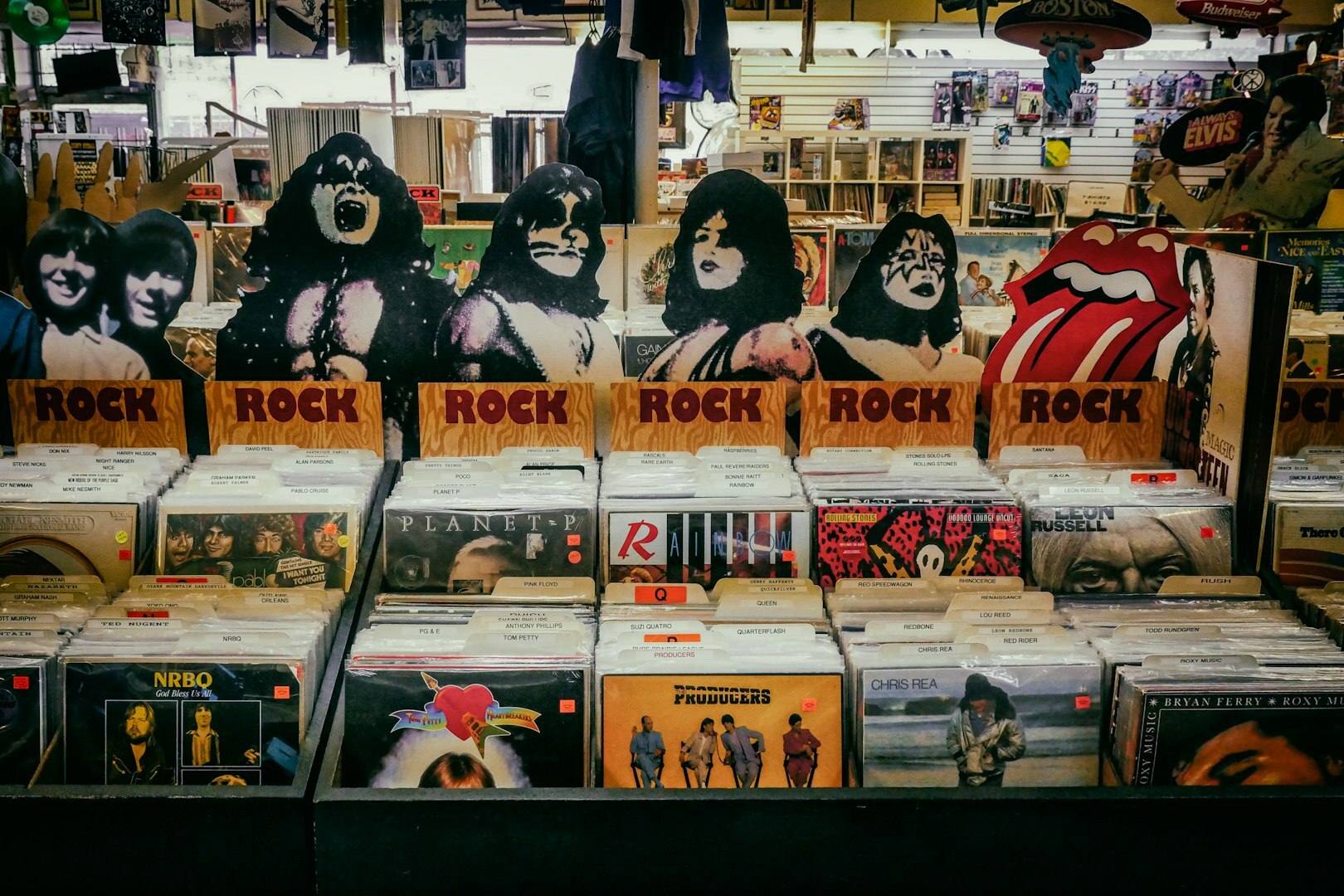
Rock and roll burst onto the scene in the 1950s as a high-energy mix of African American rhythm and blues with country and gospel. Its driving beats, raw vocals, and often daring lyrics startled the establishment, challenging conservative values and the status quo (Smith 45; Jones 102). Artists like Elvis Presley and Little Richard weren’t just selling records—they were selling rebellion, individuality, and a new attitude that resonated with a generation ready for change.
The music wasn’t only rebellious in sound; it carried a message of freedom. Teenagers found in rock a language to express desires, frustrations, and dreams previously dismissed by older generations. It was both personal and political, creating spaces where individuality could flourish.
Rooted in Black musical traditions, rock and roll played a surprising role in the Civil Rights Movement. Pioneers like Chuck Berry, Fats Domino, and Bo Diddley laid the genre’s foundation. When white artists covered their songs, it introduced Black music to a much wider, previously segregated audience. This cultural exchange helped bridge divides, showing how music can unite people and open minds (Garofalo 77; Wald 123).
Concerts, dance halls, and local jukeboxes became informal spaces of integration, where teens of all backgrounds could share in the thrill of the music. In doing so, rock subtly humanized the fight for equality, demonstrating that cultural shifts often precede social and political ones.

🖤 Turn your favorite album cover or concert photo into stunning wall art.

🖤 Make your rehearsal space or home studio sound (and look) like the real deal.

🖤 Get high-quality, legal images and vectors for album covers or posters.

🖤 Turn your band into a business. Manage gigs, invoices, and bookings without the stress.
By the 1960s, rock had transcended U.S. borders, inspiring youth worldwide. British Invasion bands like The Beatles and The Rolling Stones both honored and transformed American rock, while bringing their own cultural perspectives. Across Europe, Japan, and Latin America, rock became a vehicle for questioning authority and exploring identity. The genre created a shared, transnational language for youth culture, uniting people across continents through rhythm and rebellion.
Before rock and roll, teenagers were largely invisible in cultural narratives. The music gave them identity and voice, inspiring fashion, slang, dances, and social attitudes that defined a generation (Reynolds 58). It validated rebellion, independence, and creativity, providing young people with a space to explore and assert themselves.
As rock matured, its messages became overt. Folk-rock artists like Bob Dylan and Joan Baez combined protest with melody, addressing war, racial injustice, and inequality (Eyerman & Jamison 88; Denisoff 145). Bands like The Doors, Jefferson Airplane, and Creedence Clearwater Revival used their music to question authority and inspire activism.
The Vietnam War era cemented rock as a soundtrack for protest. Soul and rock fused in works by Marvin Gaye and Stevie Wonder, tackling civil rights and social inequities. Festivals like Woodstock and Altamont offered collective spaces for political expression, experimentation, and community solidarity. Rock wasn’t just commentary—it became a movement, a visible declaration that music could inspire change.
Rock also drove innovation in sound, from electric guitar techniques to studio experimentation. Musicians like Jimi Hendrix, Pink Floyd, and The Beatles used distortion, feedback, and multi-track recording to evoke emotions that words alone couldn’t. These sonic experiments mirrored societal experimentation: pushing boundaries, embracing new perspectives, and challenging the ordinary.
Rock isn't just entertainment—it’s a lens on society. It has shaped fashion, literature, film, and art, and its ethos of rebellion continues to influence punk, hip-hop, and indie music today. It showed that sound could carry social commentary, and that a beat could become a movement (Frith 112; Marcus 65).
Exploring rock’s cultural impact can go beyond listening:
Denisoff, R. Serge. Great Day Coming: Rock Music and the Rise of Social Movements. University Press, 1975.
Eyerman, Ron, and Jamison, Andrew. Music and Social Movements: Mobilizing Traditions in the Twentieth Century. Cambridge University Press, 1998.
Frith, Simon. Performing Rites: On the Value of Popular Music. Harvard University Press, 1996.
Garofalo, Reebee. Rockin’ the Boat: Mass Music and Mass Movements. South End Press, 1992.
Jones, LeRoi. Blues People. William Morrow, 1963.
Marcus, Greil. Mystery Train: Images of America in Rock ’n’ Roll Music. 5th ed., Penguin, 2015.
Reynolds, Simon. Rip It Up and Start Again. Faber & Faber, 2005.
Smith, Chris. The Sound of Social Change. Routledge, 2010.
Wald, Elijah. Escaping the Delta: Robert Johnson and the Invention of the Blues. HarperCollins, 2004.