The Cold War was often imagined as a monolithic struggle between East and West, ideology versus ideology, guns versus propaganda. Yet, amid the tension, rock music emerged as a quiet but potent force that bridged these divisions. While diplomats debated policies and generals flexed nuclear arsenals, the steady beat of a guitar riff or the defiant cry of a vocal line could cross borders, reach hidden audiences, and foster a subtle form of diplomacy (Starr, 2010; Regev, 2013).
The Cultural Power of Rock
Rock music became a conduit for ideas, rebellion, and identity. In countries behind the Iron Curtain, young people consumed Western rock almost as a political act. Listening to the Beatles, Led Zeppelin, or David Bowie wasn’t merely a matter of taste—it was a statement of individuality, a small resistance against oppressive systems, and a desire to connect with a larger global youth culture (Havelková, 2016; Denisoff, 2003).
"Music has always been more than notes on a page—it’s the heartbeat of societies. During the Cold War, rock music became a secret handshake among youth across divided worlds." – Music Historian (Starr, 2010)
Timeline of Key Events
1956: Elvis Presley’s early hits travel to Europe and the Soviet sphere through radio waves and imported records. His image of youthful rebellion resonates with teenagers despite government censorship (Guralnick, 1994).
1964: The Beatles explode onto global airwaves, inspiring underground fan clubs in East Germany, Czechoslovakia, and Poland. Bootleg tapes and clandestine gatherings allow youth to experience the counterculture indirectly (Covach, 2005; Regev, 2013).
1973: David Bowie’s Ziggy Stardust persona captures imaginations in Eastern Europe, demonstrating that artistic identity and style could be forms of quiet rebellion (Buckley, 2005).
1976: The U.S. State Department sponsors cultural exchange programs, sending American rock, jazz, and pop acts to Eastern Europe under the guise of “Goodwill Tours” (Von Eschen, 2004).
1981: Western rock festivals are reported in Eastern media, often reluctantly. Youth audiences interpret these events as glimpses of freedom, inspiring local musicians to experiment despite limited resources (Havelková, 2016).
1985: Live Aid’s satellite broadcast reaches Eastern Europe. The shared global event fosters solidarity, illustrating that music could unify people across continents and ideological divides (Reed, 2011).
1989: The Berlin Wall falls. Musicians from both East and West perform together on iconic stages, symbolizing reconciliation and the enduring power of rock as a cultural bridge (Starr, 2010).
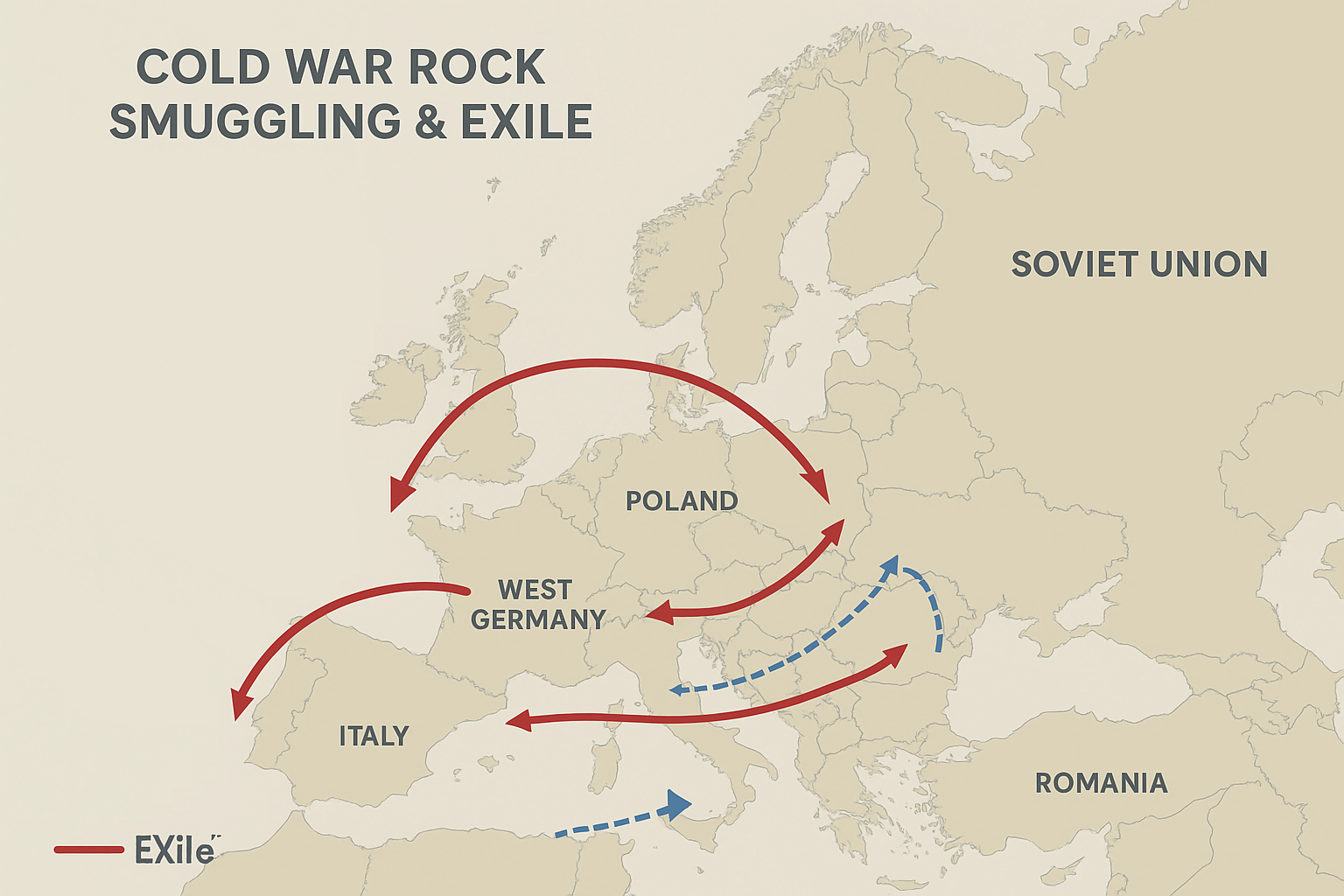
Mechanisms of Influence
Rock’s impact was not accidental. Several mechanisms enabled the music to penetrate politically restricted zones:
- Radio Broadcasts: Radio Free Europe, Voice of America, and clandestine FM stations delivered the latest tracks directly into Eastern European homes (Von Eschen, 2004).
- Bootleg Recordings: Smuggled vinyl, cassette tapes, and homemade recordings allowed fans to build underground communities, effectively creating a parallel music culture (Havelková, 2016).
- Diplomatic Tours: Carefully coordinated “Goodwill Tours” allowed select American and Western European bands to perform, creating a rare sanctioned cultural exchange (Starr, 2010).
- Visual Culture: Album art, fashion, and music videos communicated ideas of individuality and rebellion that transcended language, appealing to visual as well as auditory senses (Buckley, 2005).
Case Studies: Artists as Ambassadors
Several artists inadvertently became cultural diplomats:
- The Beatles: Their early albums inspired secret fan clubs, graffiti, and even banned fan magazines in Eastern Europe, creating shared cultural touchstones (Covach, 2005).
- David Bowie: Bowie’s shifting personas allowed listeners to explore identity and freedom in subtle, non-verbal ways (Buckley, 2005).
- Bruce Springsteen: Springsteen’s tours and politically conscious lyrics in the 1980s resonated with youth in divided Europe, symbolizing the American spirit while acknowledging universal human concerns (Reed, 2011).
Long-Term Legacy
Cold War rock diplomacy created a blueprint for cultural influence that continues today. Music festivals, global streaming, and cross-border collaborations all owe a debt to the underground networks and sanctioned tours of the 1960s–1980s (Starr, 2010; Regev, 2013). Even after the ideological walls came down, the idea that music could transcend politics remained vital. In a broader sense, rock helped normalize the notion that soft power and cultural exchange could be as influential as hard power.
In retrospect, the Cold War may have divided nations, but rock music helped unite minds. It was a reminder that human expression—through sound, rhythm, and lyrics—can bypass politics, inspire curiosity, and cultivate empathy across divides (Denisoff, 2003).
Works Cited
- Buckley, David. Strange Fascination: David Bowie – The Definitive Story. Virgin Books, 2005.
- Covach, John. “The Beatles and the Historiography of Rock.” Journal of Popular Music Studies, vol. 17, no. 1, 2005, pp. 1–21.
- Denisoff, R. Serge. Inside MTV. Transaction Publishers, 2003.
- Guralnick, Peter. Last Train to Memphis: The Rise of Elvis Presley. Little, Brown, 1994.
- Havelková, Hana. “Rocking the Iron Curtain: Music, Youth, and Politics in Eastern Europe.” Popular Music and Society, vol. 39, no. 4, 2016, pp. 387–405.
- Reed, John. Rocking the State: Music and Cultural Diplomacy in the Cold War. University of Chicago Press, 2011.
- Regev, Motti. Pop-Rock Music: Aesthetic Cosmopolitanism in Late Modernity. Polity Press, 2013.
- Starr, Larry. Red and Black: Music and Politics in the Cold War Era. Routledge, 2010.
- Von Eschen, Penny M. Satchmo Blows Up the World: Jazz Ambassadors Play the Cold War. Harvard University Press, 2004.
Explore further:
Image Credit: Freepik.com